Spring 2026 LDYF Rules
LADY DRAGON 5V5 YOUTH RULES
RULE 1. OVERVIEW
SECTION 1. THE FIELD
Article 1. Standard dimensions of the field are 60 yards long by 25 yards wide with 7‐yard endzones. Approved field sizes may fluctuate from 53‐64 yards long when necessary, or 23‐30 yards wide. Endzones should not be shorter than 5 yards.
SECTION 2. THE GAME
Article 1. Game Time is FORFEIT TIME – upon approval by an LDYF Board Member.
Article 2. Minimum 3 players to start a game. May only have up to 5 players on the field at any one time.
Article 3. A coin toss determines 1st possession. The team can elect to have offense, defense, defer or direction. Choice in the 2nd half will be awarded to the team that did not have the choice 1st half.
Article 4. The offensive team takes possession of the ball at their 5‐yard line and has four plays to cross mid‐field. Once a team crosses mid‐field, they have four plays to score. If the offensive team fails to cross mid‐field, the ball changes possession.
Article 5. If the offense does not score, the ball changes possession. All drives start from the 5‐yard line with the exception on of an interception or failed 4th down conversion, where defense takes over at the spot.
Article 6. No blocking is allowed. No intentional contact is allowed. No blocking/setting screens of ANY kind. No downfield blocking. Once a player catches a ball, ALL offensive players must stop running.
Article 7. If the offense does not score, the ball changes possession. All drives start from the 5-yard line with the exception of an interception or failed 4th down conversion, where defense takes over at the spot.
Article 8. Overtime- A coin toss will decide who chooses offense or defense first. The team on offense elects to try for a 1 point or 2 point conversion. If they achieve a one point conversion the opponent will choose to go for the tie or win. We will have 2 max rounds for extra point conversions. The 3rd round will longest yards from the 5 yard line
Article 9. Mercy Rule- 28 point difference at any time of the game. Teams can elect to keep playing, but the score will not go over 33 points.
SECTION 3. EQUIPMENT
Article 1. Members of teams must have the same color shirts They do not have to be official uniforms, but must coordinate color wise with their team and not be deemed too close in color to the opposing team by a ref.
Article 2. Approved football sizes:
• 2nd/3rd Grade Division: Pee‐wee, junior, and youth size footballs allowed
• 4th-6th Grade Division: Junior and youth size footballs allowed
• 7th/8th : Youth size football
Article 3. Teams must wear Lady Dragon Provided flags.
SECTION 4. COACHES
Article 1. Coaches are volunteers whose role it is to help young people learn to play and enjoy football. Parents are encouraged to support their youth and their coach at all times.
Article 2. One Coach is permitted on the field to assist players with their position on alignment and mentoring on offense and defense. At the snap, the on‐field coach must be 5 yards behind the quarterback and are not allowed to continue instructing or coaching until the play ends. All other coaches who come on the field at anytime during a game will be penalized. One sideline warning per game will be issued a er which the following penal es will result:
• Coach on the field during live action = unsportsmanlike conduct
• Coach on the field during a dead ball = delay of game
Article 4. ONLY THE HEAD COACH CAN ADDRESS THE GAME OFFICIALS.
SECTION 5. GAME CLOCK FORMAT
Article 1. Two 20‐minute halves and 5‐minute halfime.
Article 2. Each team has two 30 second timeouts PER GAME. If a timeout is called after a TD the clock will not run until the change of possession and the offense snaps their ball.
Article 3. The play clock is 35 seconds from the end of the previous play.
SECTION 5. FIRST HALF CLOCK
Article 1. The clock will run continuous during the 20 minutes of the first half unless a team timeout is used or play is stopped by an official (e.g. deal with an injury, challenge, referee conference, game management purposes, etc.)
Article 2. The head official will give a verbal two‐minute warning (for rule specific changes inside 2 minutes)
Article 3. The clock will run during point‐after‐touchdown attempts (PATs) in the first half unless either team opts to use a team timeout.
SECTION 6. SECOND HALF CLOCK
Article 1. In the second half the clock will run continuously run for the first 19 minutes unless a team timeout or an official’s time out is used.
Article 2. The one‐minute warning will stop the clock in the second half if the score difference is 8 points or less.
Article 3. The head official will give a verbal two‐minute (for rule specific changes) and one‐minute warning as close as possible to the actual marks but will not interrupt a live play.
Article 4. At the one minute warning officials will use a ‘stop’ clock mechanic for the remainder of the contest.
RULE 2. OFFENSE
SECTION 1. RUNNING
Article 1. The quarterback may not run unless the ball has been thrown back, handed or pitched to her in the backfield.
Article 2. Teams may handoff unlimited times in the backfield. Handoffs are allowed forward or backwards when behind the line of scrimmage, and only backwards beyond the line of scrimmage. A handoff DOES NOT count as a lateral/throwback.
Article 3. Lateral rules:
• 5th Grade and younger may lateral once behind the line of scrimmage per play, but may not lateral or pitch at anytime past the line of scrimmage.
• Any player who receives a handoff, pitch or lateral behind the line of scrimmage may throw the ball as long as he or she is not fully beyond the line of scrimmage.
Article 4. A forward pass DOES NOT have to cross the LOS to be a legal play.
Article 5. If the ball is placed on the “Back” of ANY player, the player MUST run the ball (no give and go to the QB on the back)
Article 6. No run zones are located 5 yards before mid‐field and 5‐yards before the end zone. You may not run the ball in the no run zone (5‐yards before the first down and end zone), only forward passes are allowed.
Article 7. Ball is spotted where the ball is at the time of the flag pull. The ball must break the plane of the midfield or goal line to be considered a first down or touchdown.
Article 8. Players may NOT block down field in any form.
SECTION 2. PASSING
Article 1. The quarterback has 5 seconds to pass the ball. If the ball is not thrown, then the play is dead. After the ball is ruled dead it is returned to the line of scrimmage.
Article 2. Once the ball is handed off or pitched backwards the 5 second count stops.
Article 3. There is no arm in motion, if the ball is in hand when the quarterback’s flag is pulled then it will be ruled a sack.
Article 4. Interception may be returned.
Article 5. If ANY part of the players body is behind the LOS it is a legal pass
SECTION 3. RECEIVING
Article 1. All players are eligible to receive a pass, including the quarterback, if the ball has been pitched or handed off in the backfield.
Article 2. Players must have at least one foot in bounds when making a catch.
RULE 3. DEFENSE
SECTION 1. RUSHING THE QUARTERBACK
Article 1. There is no rushing.
SECTION 2. PASS COVERAGE
Article 1. Contacting receivers is not allowed.
Article 2. Pass interference normally occurs above the waist; entangled feet are not considered pass interference.
Incidental contact is not considered pass interference.
Article 3. A player may “find” their opponent by reaching out and placing a hand on them as long as touching does not delay, impede, twist, or turn their opponent. This is not considered pass interference.
Article 4. A player may use their arms or hands to intentionally obstruct the receiver’s view (face guarding) of the ball without turning their own head to play the ball as long as noteworthy contact is not made with the receiver.
Article 5. If defensive pass interference occurs in the end zone the ball will be placed on the one‐yard line, automatic first down.
Article 6. Interceptions may be returned. Interceptions in the end zone that are not returned to the field of play will result in a touchback and the ball will be spotted on the 5‐yard line.
Article 7. Contact away from the direction of the pass is not considered pass interference but may be considered illegal contact.
Article 8. Whether a pass is catchable or uncatchable has no bearing on pass interference. The benefit of the doubt is given to the receiver. Examples of pass interference include:
• Shoving or pushing off to create separation.
• Playing through the back.
• Hook and turn: grabbing the torso and turning an opponent before the pass arrives.
• Arm bars, hooking, restricting, grabbing wrists, or turning a receiver.
• Blocking downfield before the ball has been touched, commonly seen through “pick plays”.
RULE 4. SCORING
SECTION 1. POINTS
Touchdown: 6 points
• Point after Touchdown:
-(PAT) 1 point from the 5‐yard line (no‐run zone in effect)
-2 points from the 12‐yard line, run, pass (outside of no‐run zone)
-Interceptions returned on PAT’s are worth 2 points
• Safety: 2 points
• Interceptions on any PAT can be returned by the defense for two points regardless of PAT point attempted.
SECTION 2. POINT AFTER TOUCHDOWN (PAT)
Article 1. Following a touchdown, once the scoring team has informed an official of which point conversion choice they want to a empt, the decision cannot be changed unless the scoring team uses a team timeout.
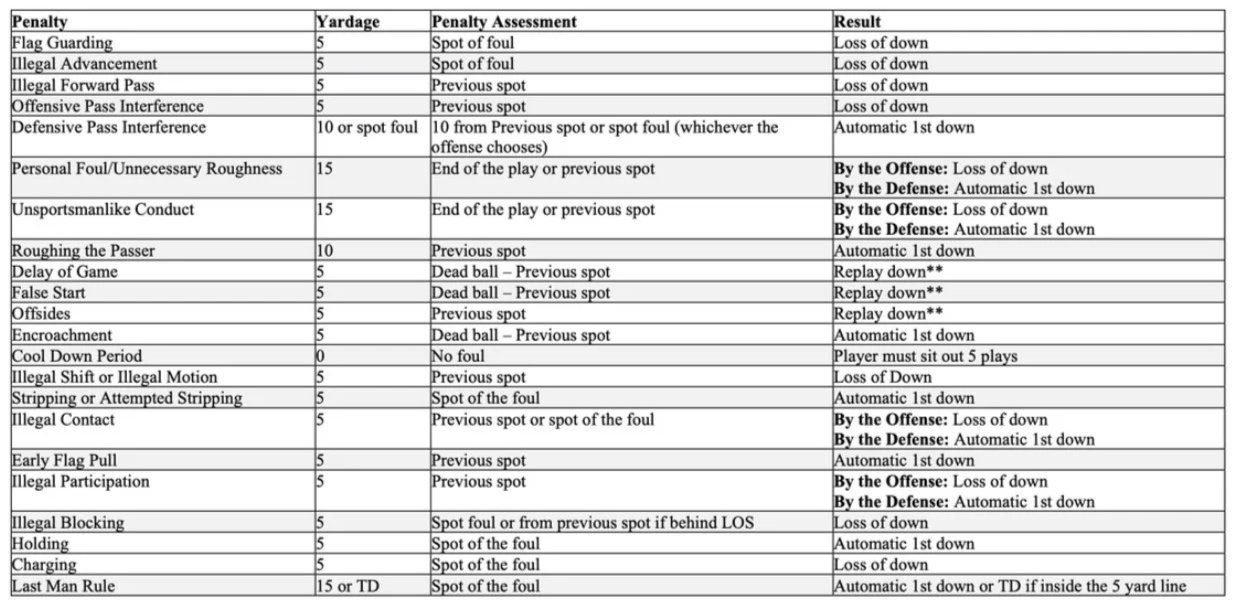
Article 2. If a penalty occurs during an extra point attempt, the penalty will be assessed but the extra point value remains the same.
Article 3. Decisions cannot be changed after a penalty. For example, if the offense attempts a 1‐point PAT and is penalized five yards for a false start, they cannot change their mind and go for a 2‐point PAT. They will be attempting a 1-point try even if they call a timeout.
Article 4. Defensive unsportsmanlike conduct, personal fouls, or roughing penalties during a successful touchdown attempt will be assessed at half the distance to the goal during the PAT attempt (e.g., 2‐point PAT attempts will be spotted at the 6‐yard line, 1‐point PAT attempts will be spotted at the 2.5‐yard line). All other defensive penalties may be declined by the offense and the score will stand.
Article 5. Dead ball fouls committed by the offense that do not carry a loss‐of‐down penalty (false start) may result in penalty yardage assessed and the down replayed.
Article 6. Fouls by the offense during a successful PAT attempt that carry a loss‐of‐down penalty (flag guarding, illegal advancement, illegal forward pass, etc.) will result in the PAT being no good.
Article 7. Fouls committed by the offense in unsuccessful PAT attempts will be declined by the defense and the PAT will be “no good” and will not be replayed.
Article 8. Fouls by the defense during an unsuccessful PAT attempt will result in a retry after the options are administered.
Article 9. If the PAT‐attempting team throws an interception and then commits a flagrant foul after the interception during the attempted return (physically contains the ball carrier; bear hugs, aggressively holds, tackles, etc. without making a clear, legal attempt to pull the ball carrier’s flag, the ball carrier will be awarded two points.
SECTION 3. OVERTIME EXTRA POINT SHOOT‐OUT
Article 1. A coin flip determines first possession, 1 timeout per OT period
Article 2. Teams will go in reverse order if more then 1 OT is required
Article 3. Teams can elect to go for 1 or 2 points
Article 4. Winner will be determined once the value of the extra point exceeds the other team’s attempt.
SECTION 4. MERCY RULE
Article 1. No Mercy Rule.
SECTION 5. PENALTIES INSIDE 2 MINUTES
Article 1. All penalties inside of 2 minutes of BOTH halves remain the same except:
• Defensive delay of game (+ 15 yards Unsportsmanlike & AFD)
• Intentional Offensive delay of game (‐15 yards Unsportsmanlike & LOD + clock stops)
• Offensive Pre‐snap penalties – yardage + LOD + clock stops